Thursday, February 17, 2011

SIZZLING SUMMER

While the many parts of the world are experiencing extreme weather. I am happy to report that in the Western Cape all is normal. The southeaster blows more days than not, the sun shines every day and the temperature is in the early to mid thirties. (Celsius) In my part of the Cape this means hot dry gale force winds have been battering my garden since early December. Although this is routine for this time of the year it doesn’t make it pleasant.
I have had to break my no water rule, as my front garden only established in April 2010 was just crying for water. I have specifically chosen water wise plants that once established will survive our harsh summers, but at the moment some are still too young to endure the daily onslaught of sun and wind. I believe the key to developing strong drought resistant plants is to encourage strong root growth and so if I do water them it is only once a week or even less but then they get a good long soak down at the roots.

Although many plants have taken a battering from the harsh conditions I definitely have some drought tolerant stars


Indigofera jucunda


Gazania rigens


Bulbinella frutescens


Orphium frutescens


I enjoy summer as we get to swim and braai (barbecue) a lot, but by February I have to admit I start looking forward to autumn. Autumn brings relief from the constant wind and the temperatures become more bearable. April is also the best time to plant new plants. As my veggie blogging friends examine seed catalogues I find myself looking for bulbs and studying reference books and the net to find new plants to add to any available space in the garden. 

Since I cant do much in the garden we have taken the opportunity to revisit Botanical Gardens and Nature Reserves. In mid January we visited the Harold Porter Botanical Gardens. The pictures will tell the rest.....


Fynbos looks dead boring from a distance, you have to walk in it to appreciate the beauty


Bright red Crassula coccinea


Ericas showing off their dainty beauty


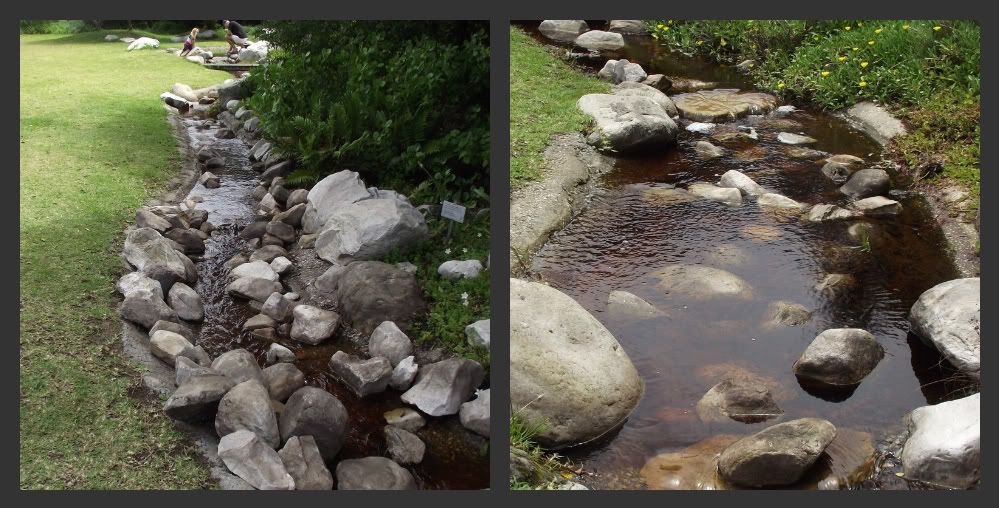
This stream has been colored by the fynbos.

Monday, January 17, 2011

My Garden Plans for 2011

This one is especially for Fer’s carnival. See mygardeninjapan.
I have great plans / dreams for my garden for 2011. Maybe with a little advice and encouragement from my blogging friends, I will be able to make my dreams a reality.
We get mostly winter rainfall and for the past few years I have been really upset about all the water going down the drain. In summer when it is really dry I keep wishing we had some of that precious water. The first thought was to install rainwater tanks, but they are ugly and expensive as well.
So I came up with the great idea of building a river bed and leading it into a pond. The rainwater can be led from the gutter into the river bed and then into the pond. If the pond gets too full I have planned a bog area. We have a lot of bulbs that grow in temporary winter ponds and then like to be totally dry in the summer.
We plan to do this in our back garden where we already have a small pond that can be incorporated into the design. If this one works out well then I would like to do the same in the front garden – but don’t tell my husband – he is already groaning about the amount of work ahead.

On Sunday we went to the Harold Porter Gardens in Betty’s Bay to get some ideas. The pic below gives an idea of what I trying to create.


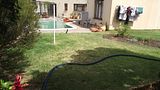
This is the area I have to work with.


The area in the shade behind the blue pipe will remain grass. The area in the sun extending towards the pool will become bog and pond. The river will run down on the left and fall into the pool somewhere after the white pole – old wash line post that will finally be removed.


Same thing just from the opposite side. The existing pond is in the back ground. The rainwater pipe will be led along the back wall, which will hopefully be hidden  soon by a few young trees and shrubs that were planted a few month’s ago. 


Hubby contemplating the work ahead.

So quite a big task ahead, all the help, advice and encouragement will be appreciated.


Wednesday, January 12, 2011

The Dating Game

I am one of those people that believe every cloud has a silver lining and you must grab opportunities with both hands.
In February 2010 hubby was generously helping trim some overgrown shrubs in our front garden. Somehow he managed to twist his neck and probably due to a car accident 3 years ago he ended up crushing the disc between the 5th and 6th vertebrae. That resulted in an operation to fuse the 2 vertebrae and having to wear a neck brace for six weeks.
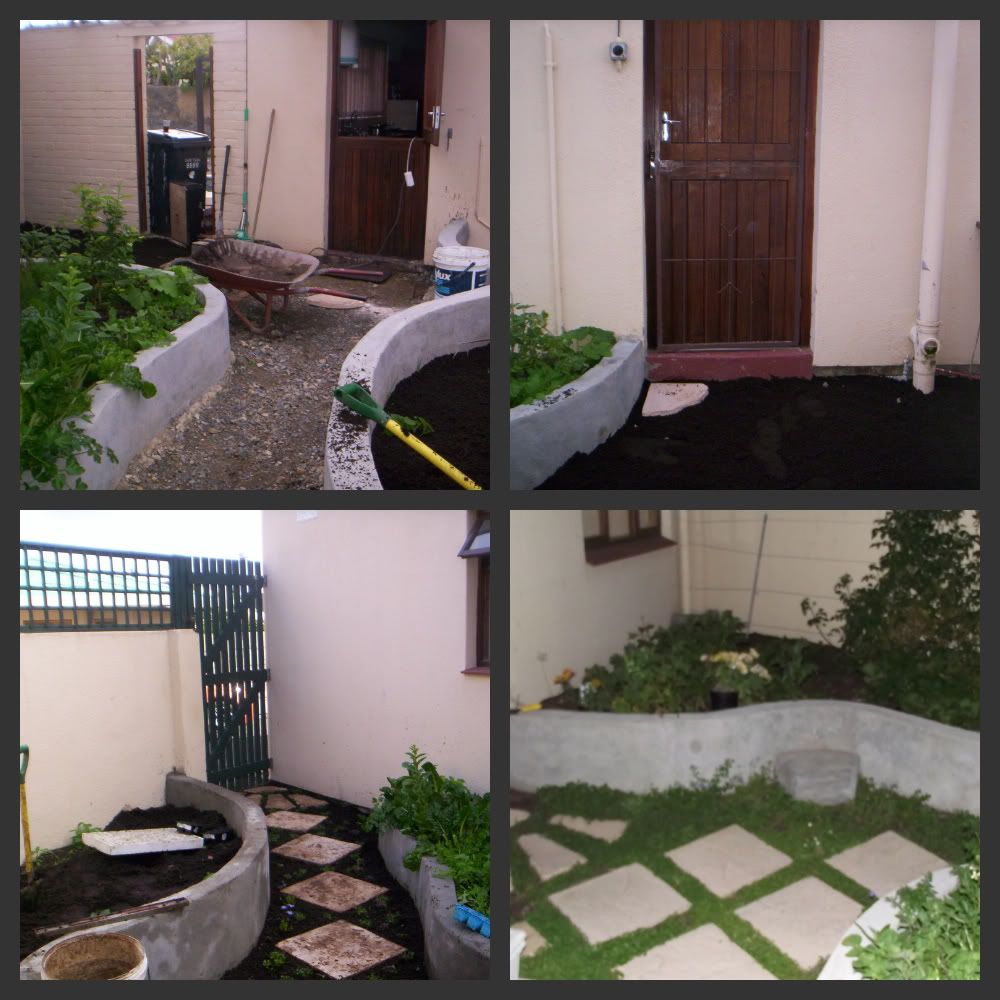
Problem: What to do with an ugly patch of tar outside your back door and a husband that can’t sit still
Solution: You hire 2 willing helpers and you get hubby to supervise. Remove the offending tar, build some curvy walls, bring in loads of compost and soil and voila you have a veggie patch.
Since then we have added some pavers on the pathway and have planted wonder lawn, pennyroyal, oreganum and felicias in between. The ever present alyssum have made themselves at home too.


We have had some disasters in the patch like the lettuce and rocket bolting, the strawberries dying and the cauliflower not getting heads.
But we have also enjoyed quite a few meals with cherry tomatoes, lettuce and swiss chard
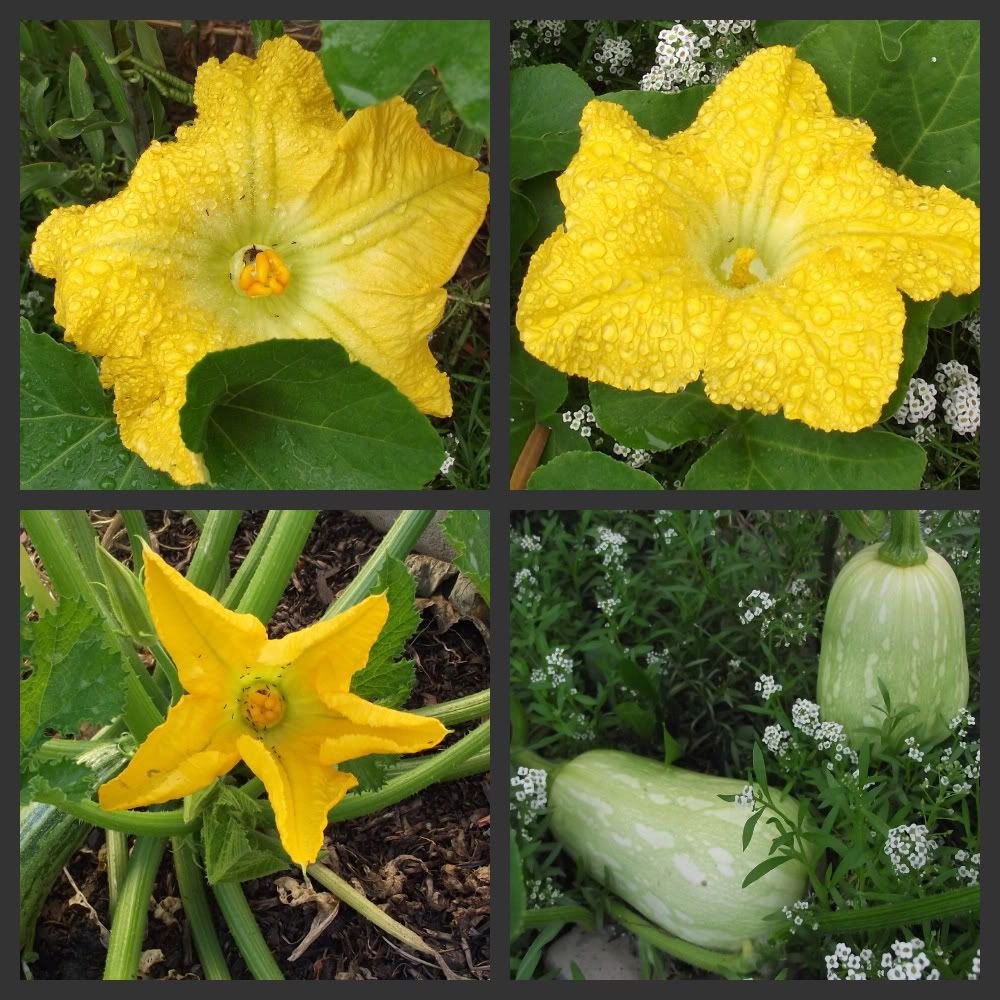
At the moment we have zucchini and butternut growing. Being the novice gardeners that we are, we couldn’t understand why the butternuts would grow to about 5cm and then die. Luckily Mark my favourite veggie/cooking blogger from the UK soon put us right.
Apparently our butternuts needed some help in the bedroom area and so started the dating game. Every morning I dash outside and look for male and female flowers so that I can hand pollinate them. Some mornings I am lucky and there are equal amounts of males and females and then everyone is happy, and other days I am not so fortunate and someone becomes the proverbial wallflower. Not sure I am doing it right but I pretty much destroy the male in order to pollinate the female – it seems a little like the praying mantis who bites off her suitors head after he has fulfilled his purpose. I wonder if the human race wouldn’t turn out better if we girls got something like that going. Just kidding guys!

Sunday, January 2, 2011

Why I Garden

I think gardening is in my genes. My great grandfather was curator of the Durban botanical gardens and later became a nurseryman. My grandparents had a child’s dream garden, lots of lush green lawn to play on, great trees to climb in, lots of places for hide and seek and always plenty of mangoes, pawpaws and litchis ready for picking.
My father too loved his garden and more often than not he would come back from his morning walk nursing a cutting kindly snipped by a friendly neighbour.
But I think to me gardening is more than just creating a beautiful picture. To me it is about trying to preserve our natural beauty.
I have always loved walking on wild untouched tracts of land hoping to and always finding a shrub or flower I hadn’t seen before, then the botanist in me would rush back home and dig out the gardening books and try to identify it.
It saddens me to see what we have done to our beautiful planet. Even with all the Green movements I think most people are too busy to live really eco conscious lives.
Gardening helps to absolve some of the guilt I feel about the destruction of our earth.
If I can restore just one little space with what nature intended then I feel I have taken a step in the right direction.
Regrettably my garden will never make the front page of a garden magazine, but at least I know I have done no harm – I have not sprayed herbicides, pesticides and fungicides, I have not used chemical fertilizers. Occasionally my plants look rather sad when they have been attacked by some or other insect or disease but they generally bounce back and hopefully next season they will be stronger
Writing this set me thinking about the Hippocratic oath and one phrase stands out – “first do no harm” So I have borrowed a little and written my own.

 I swear by Hegemone, the goddess of plants, and the Horae, the goddesses of the seasons, to keep according to my ability and my judgment, the following Oath and agreement:
I will consider dear to me all that is natural, and will strive to preserve as much of nature as humanly possible. As my parents have taught me this art so too I promise to teach my children.
I will follow routines for the good of my plants and the earth according to my ability and my judgment and never do harm to anything.
I will not poison, pollute or contaminate the earth, but will garden in accordance with the laws of nature.
I will preserve the purity of my life and my environment.
I promise to restore what those before me have destroyed.
I will harvest only enough for my needs and will leave sufficient to feed god’s creatures and ample seed to allow plants to multiply.
If I keep this oath faithfully, may I enjoy my life and practice my art, respected by all men and in all times; but if I ignore it, may the opposite be my lot.

 I guess if I am to honour my oath I will have to find another way to deal with the snails and stop killing the little horrors!


BULBINE FRUTESCENS
STALKED BULBINE


DESCRIPTION: This clump forming succulent perennial is a must have for almost any South African garden. It makes an ideal ground cover for dry sunny areas. It bears beautiful orange or yellow star shaped flowers with prominent yellow stamens. The flowers appear almost all year round except for a few months in winter. When broken, the leaves ooze a gel that helps soothe insect bites and stings and quickly stops bleeding from cuts and scrapes. It is also useful for treating eczema and soothing chapped lips.
DISTRIBUTION: Widespread in SA, it is found along the coast from Namibia spreading down to the Peninsula and extending along the south and east coast and inland as far as Mpumulanga.
CULTIVATION: Grows easily in any sunny spot. It produces fewer flowers if planted in light shade. It grows from seed and cuttings, but is easiest by division of the rhizomes. Although it appreciates the addition of compost it does well in poor sandy soils. Bulbine is a water wise plant, tolerating long periods of drought.

Sunday, December 12, 2010

More Snails


Well I did a little research (thanks Wikipedia) and discovered that most of us have the same pesky snail in common. It is known as Helix Aspera and originated in the Mediterranean area. They have since spread far and wide and become a pest to most gardeners. However some creative Capetonians have started harvesting them from our vineyards and exporting them to restaurants overseas. The really weird thing is apparently our local restaurants prefer a different type of snail and so we import it! What a crazy world we live in. Lately I have seen ads for face cream made from snails; apparently it’s great for wrinkles and scars. Maybe sticking them to our faces while we do our morning gardening chores will chase away  few wrinkles.The only other bit of useful information that I could glean is that this snail has an aversion to copper so putting copper bands around precious plants may offer some protection.
My garden doesn’t only suffer from the brown snail; I have another little monster that mostly confines itself to a small front bed containing pelargoniums and gazanias. I think I detest this one more then the big brown one as it is much smaller and more proliferous and consequently more difficult to collect. Again thanks to Wikipedia I think this culprit is Theba pisana, also originating from the Med and fast becoming a major problem in the USA.

Orpheum frutescens


Finally the Orpheum frutescens that I planted in the new front bed is flowering. I am really thrilled at how good it is looking. The glossy pink star like flowers with prominent yellow anthers make a lovely show when clustered near the tips of stems covered with bright green leaves. All the gardening books say it likes lots of water but mine is flowering despite the fact that it has been hot, dry and windy and I seldom water the front bed. By seldom I mean maybe once every six weeks.
The texture of the flowers is hard to describe – they have a waxy almost sticky feel to them, but they leave no sticky residue on your fingers. Something else amazing about his plant is the way it is pollinated. The anthers on this plant are intertwined and only unlock to a certain frequency of wing beat created by a particular bee. This is called buzz pollination.
This plant is great for difficult areas close to the sea as it tolerates poor sandy soils and doesn’t mind the salt–laden air.
The garden fundi’s also say it needs to be replaced every few years – time will tell!

Tuesday, November 23, 2010

Snail Invasion

While our hot dry winds continue to blow almost daily, we had some welcome rain over the weekend. But along with the rain came snails - literally hundreds of them. I refuse to use poisons so the only way to get rid of the little horrors is to collect them by hand. In less than an hour I collected 5 coffee jars full! Now comes the crazy and cruel part - I drown them in boiling salt water and then leave the shells to dry in the sun for a few weeks. When the shells are totally dry I use them to cover the bare soil in my pot plants. Does anyone have a more humane way of controlling these destructive creatures?

Lobostemon fruticosus


This bush is also known as Agtdaegeneesbos (8 Day Healing bush). The early Cape inhabitants believed this plant would cure a multitude of ills within 8 days, hence the name. I have nicknamed it the Cinderella bush. Why? Well I planted this rather boring looking shrub in the new front bed in April. Its grey green leaves covered in soft hairs made it almost unnoticeable amongst the other plants. But in late August it suddenly burst into flower. I couldn't believe it was the same unremarkable plant. It was covered in the most beautiful light pink buds and when open the flowers are pale blue on the margins and pink at the bottom. It just made me think of Cinderella dressed up for the ball. It continued to flower until almost the end of September and then all the flowers faded and disappeared and it returned to it's dull existence. I thought I would have to wait until Spring to see it bloom again, but this little bush had a surprise in store for me - mid November and it is flowering again!
It grows up to 1 metre high and equally wide and is multi-stemmed. It self seeds freely in its natural habitat, but can also be cultivated from cuttings taken in Spring and Autumn. It occurs on the West Coast from Namaqualand to the Peninsula


Tuesday, November 2, 2010

Summer is here!

Summer is definitely here. The South easter has been blowing for 3 days and yesterday the the temperature reached 30 degrees celsius. Time to bring out the hats and sunblock. It is weather like this that really makes one appreciate our indigenous flora, most alien plants would be wilted and crying out to be watered but our local plants seem to almost relish this weather. This weeks feature plant is a perfect example - it looks so delicate you wouldn't think it could handle our harsh summer, but as the wind blows it reveals the silver under sides of the leaves creating waves of green and silver.

Geranium incanum
Carpet geranium


DESCRIPTION: This geranium has finely divided mid green leaves with grey undersides. Deep purple or occasionally very pale mauve to white flowers cover this plant almost all year round. In my garden the paler flowers are also somewhat smaller than the flowers on the deeper purple form. The carpet geranium makes an ideal ground cover; fast growing it makes a dense carpet about 300mm high. Bees seem to love this plant and there are always a few buzzing busily around.
DISTRIBUTION: Geranium incanum is common in the south western and eastern parts of the country.
CULTIVATION: Like all geraniums this one grows easily from cuttings and seed. It flowers better in full sun but will tolerate semi-shade. The carpet geranium is perfect for sloping banks and is equally happy in hanging baskets.