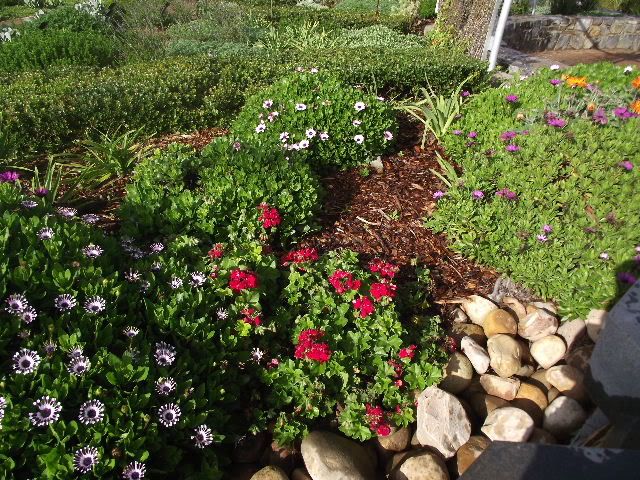
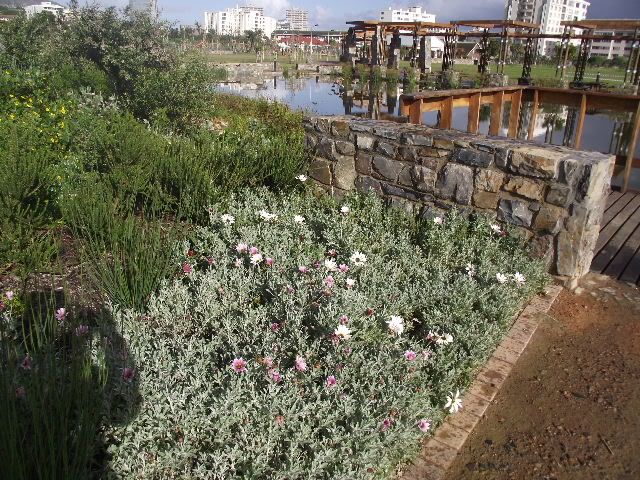
This blog is essentially about transforming an old established garden filled with exotics into one that boasts only plants from South Africa and more specifically from the Western Cape.
For various reasons this transformation will take place over a number of years. One of these reasons is that a garden makeover takes time and money, both of which are in short supply. Another is that I hope that some of the existing plants will provide protection and shelter for the new plants while they try to establish themselves. Finally I spend hours buried in books and the internet trying to decide on the most suitable plant for each area. With approximately 8500 different plant species in the Cape Floral Region this is no easy choice.
I have been waiting for autumn to trim back a very overgrown hibiscus and coprosma in our front garden. Once cleared I will have room for planting some new trees in winter. On the weekend hubby and I armed with hedge clippers and bow-saw attacked the targeted shrubs. After a few hours in the baking sun we had a huge pile of branches. We retired for a well deserved drink and left the clearing up for another day. Next day while I was back in the office hubby came home to finish cleaning up. When everything was cleared away he noticed a tree that had been growing in the midst of these two shrubs. I couldn't wait to get home to identify it, hoping all the time it would be something indigenous that I could save.

Identifying trees is not easy, There were no flowers so I studied the leaves. are they simple or compound? Are they opposite or alternate? Are the margins toothed or smooth? All of these answers still leave you with thousands of possibilities. The tree has grown quite tall with no branches near the bottom. The other shrubs had totally encircled it and so the only place to grow was up. Finally I spotted a small fruit. Out came the gardening books – with each possibility I consulted the internet for further information. After more than an hour I thought I had it, but I wasn't totally sure. Trouble was the fruit I had picked was closed – silly me hadn't opened it. I called hubby over to confirm my guess. Why don't you open the fruit and then you'll know? Voila! Opening the fruit solved the mystery- I have a wild peach. Kiggelaria Africana. I couldn't believe my luck, this was one of the. trees on my shortlist of possibles to plant. Now I have an established tree that just needs to be nurtured, it has suffered a bit of damage to some branches by chafing up against the other shrubs. I am sure with the coming winter rains and the space it now has it will flourish.


Kiggelaria Africana
Evergreen tree to about 11m and spreading almost equally. It can reach almost 20m in favourable conditions. Low branching with a non aggressive root system. Mine has branched quite high up due to its restrained growing conditions. The bark is smooth when young becoming rougher with age.
The wild peach carries bell shaped flowers with male and female flowers on separate trees. The fruit is small, approx 15mm diameter on my tree, round rough and greeny yellow. When ripe it splits open in four parts revealing black seeds covered in a bright orange – red sticky covering. A wide variety of birds including robins , mousebirds and white-eyes love this fruit. It is also host to the caterpillars of Acraea butterflies. These in turn attract cuckoos.
Kiggelaria africana grows in a wide variety of habitats and is found from the Western Cape through to Kenya.